What to see in Turin on foot
14 places with their stories, the map and free audio in 15 languages.
Updated November 2026 · 3 min read · Produced by World Tour
Turin in a nutshell
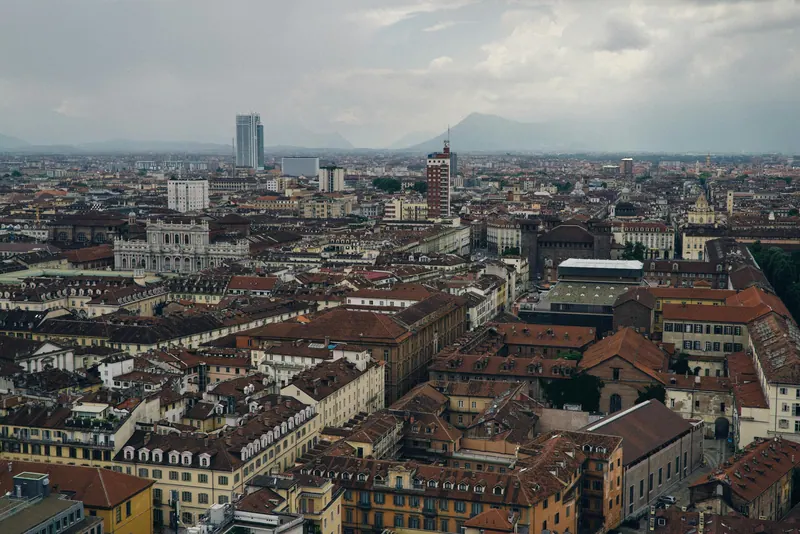
Turin is a city located in north-western Italy, at the foot of the Alps and bathed by the River Po. It is a region with a deep and elegant history, where art, politics and industry have coexisted for centuries. Its origins date back to a small Celtic settlement called Taurasia, conquered by the Romans in the 1st century BC and renamed Julia Augusta Taurinorum. As a Roman city, Turin had the typical grid layout, with straight streets that still define the layout of the historic centre today.
The places on the map
Each number is the place’s number in the list.
Turin Walking Tour
-
1. Piazza San Carlo
Now, take a good look at this square. It’s one of the most elegant and iconic places in Turin.
-
2. The Legendary Caffè Torino
This is one of the most iconic and historic cafés in the whole city. It was founded in 1903, and over the years it’s welcomed the great names of Piedmont’s aristocracy as well as the new bourgeois world that was emerging during the industrial boom.
-
3. The Sobriety of Turin
You’re now leaving the square that marks the entrance to the oldest district of Turin. Back in the days of the Roman Empire, this area was where the city’s two main streets crossed: the Cardo, running north to south, and the Decumanus, running east to west.
-
4. The Egyptian Museum
This is the most important Egyptian museum in the world after Cairo’s. Its origin mixes history and a touch of legend. For centuries, the House of Savoy promoted the idea that the city had been founded by an Egyptian prince.
-
5. Piazza Carignano
You’re standing in front of the Farmacia del Cambio. It was founded in the 18th century and was connected to the Ristorante del Cambio, one of the oldest restaurants in Italy and a favourite among ministers, aristocrats, and writers.
-
6. The Other Face of the Palace
The façade in front of you has nothing to do with the curved brick one we saw earlier. Everything here changes: the lines are straight, balanced, and orderly; the windows are perfectly aligned; and the decoration is much simpler and more symmetrical.
-
7. Galleria Subalpina
Here we are at another of Turin’s hidden gems. The name Subalpina comes from its location — literally “beneath the Alps.” It was inaugurated in 1874 and connects Piazza Castello with Piazza Carlo Alberto.
-
8. Palazzo Madama
What you’re looking at now is the back of the palace — the oldest part, the one that still looks like a medieval castle, with its two circular towers, dark brick, small windows, and that unmistakable defensive air.
-
9. The Reliefs
Here you can see two reliefs. The first one, at the top, shows a First World War soldier advancing with his rifle. On one side you can read 1492, and on the other 1915–18. That is not a coincidence.
-
10. Piazza Castello
This is the most important square in Turin and, for centuries, the political heart of the entire Kingdom of Savoy. What you have in front of you is not a new castle but the Baroque façade of Palazzo Madama, which we visited a moment ago.
-
11. The Royal Palace
Now we’re going to talk about the most important building of the Savoy dynasty in Turin. And if you look at it from the outside, you might be surprised by how simple it is.
-
12. The Cathedral of San Giovanni
This is the most important church in Turin in religious terms, because it is the one that houses one of the most famous relics in Christianity: the Holy Shroud. But before telling you about the shroud, let’s understand a bit of the history of this place.
-
13. The Holy Shroud
Now that we’re inside, let’s clear up the most important question: where is the Holy Shroud? The original relic is not on display all the time. It’s kept in an armoured case, protected by strict controls of temperature, humidity and security.
-
14. The Palatine Gate
This is one of the best-preserved Roman monuments in all of Europe. It’s not a replica — this gate is more than 2,000 years old. It was the main entrance to the ancient Roman castrum, the military camp from which Turin was born. Look closely at the walls: they’re authentic.














Walk them with the app
The tour visits these places in order, with the full audio and the map. Free, with no sign-up.